
Landscaping (2025)
A video installation
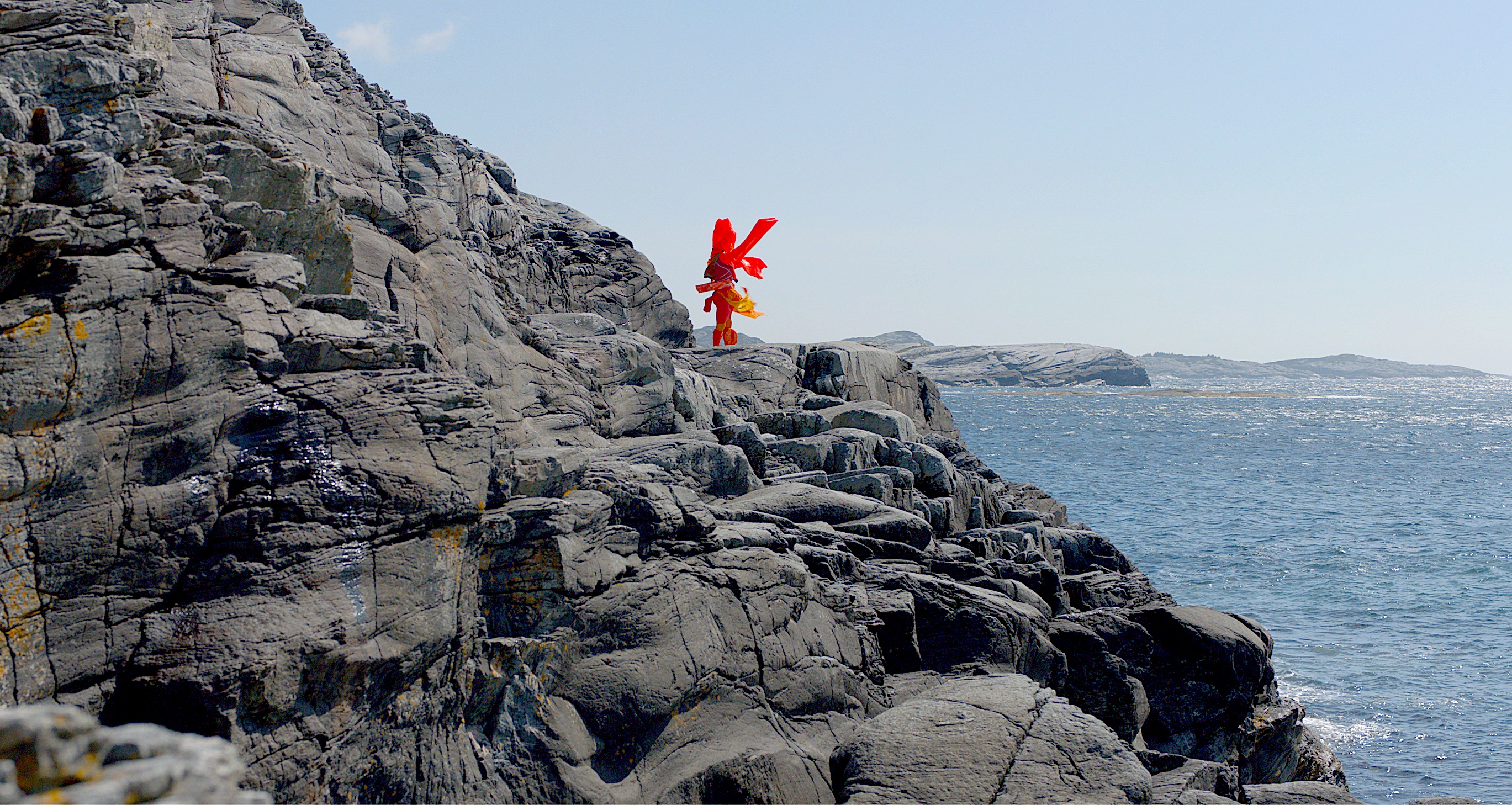
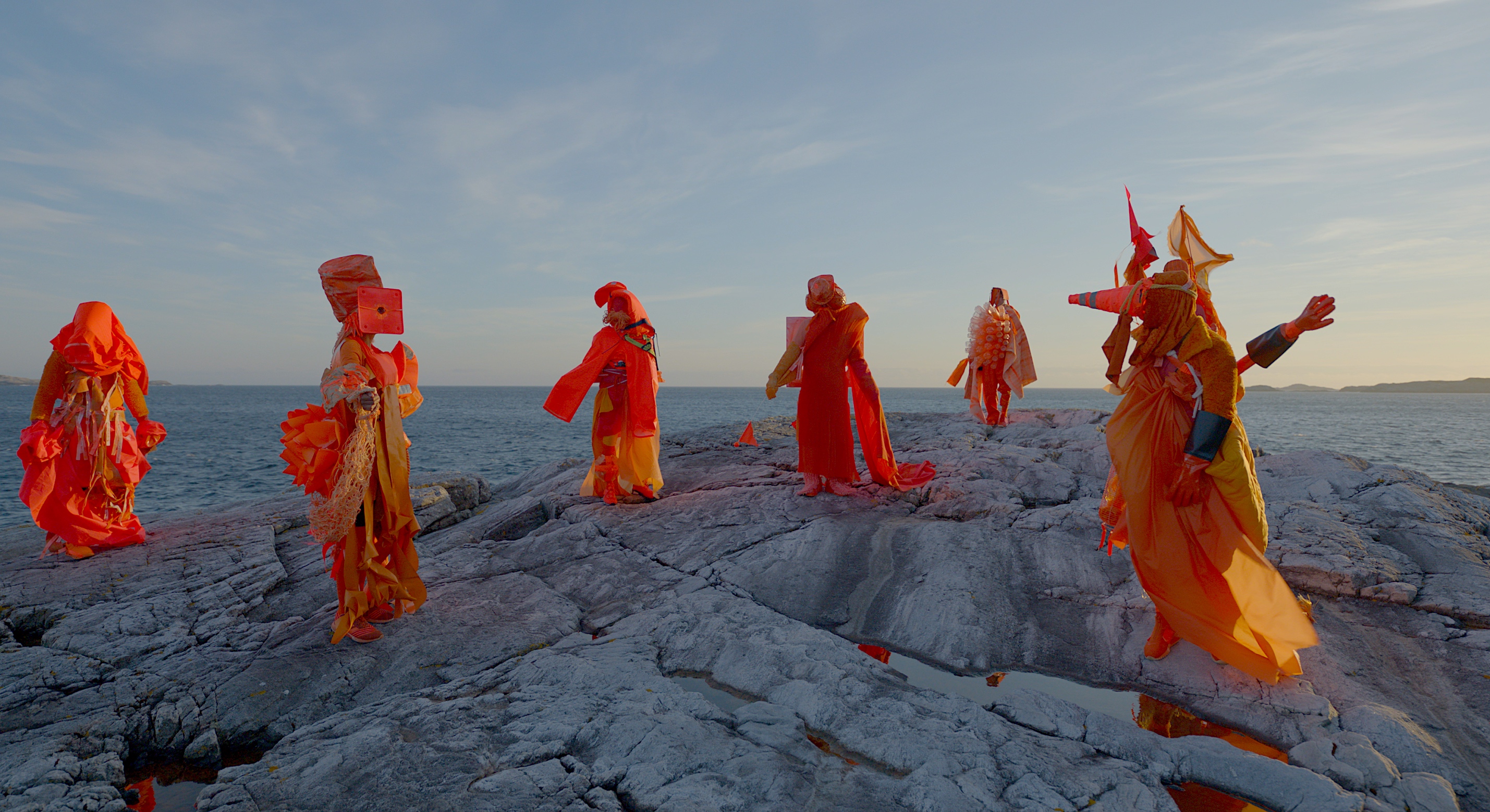
In a post-apocalyptic present, a nomadic community survives by traveling from island to island according to the seasons. Strange beings made of detritus, objects and materials washed up by the ocean, laden with toxic particles, they are no longer truly human. Their mutated bodies have found new senses to feel the heat, capture the sounds that nourish them, perceive the waves that orient them. So they follow the movement of the sun, entering into rituals that connect them with the cosmos. Now cleansers of their infested world, they seek alliances with the living organisms and mineral forms that surround them.
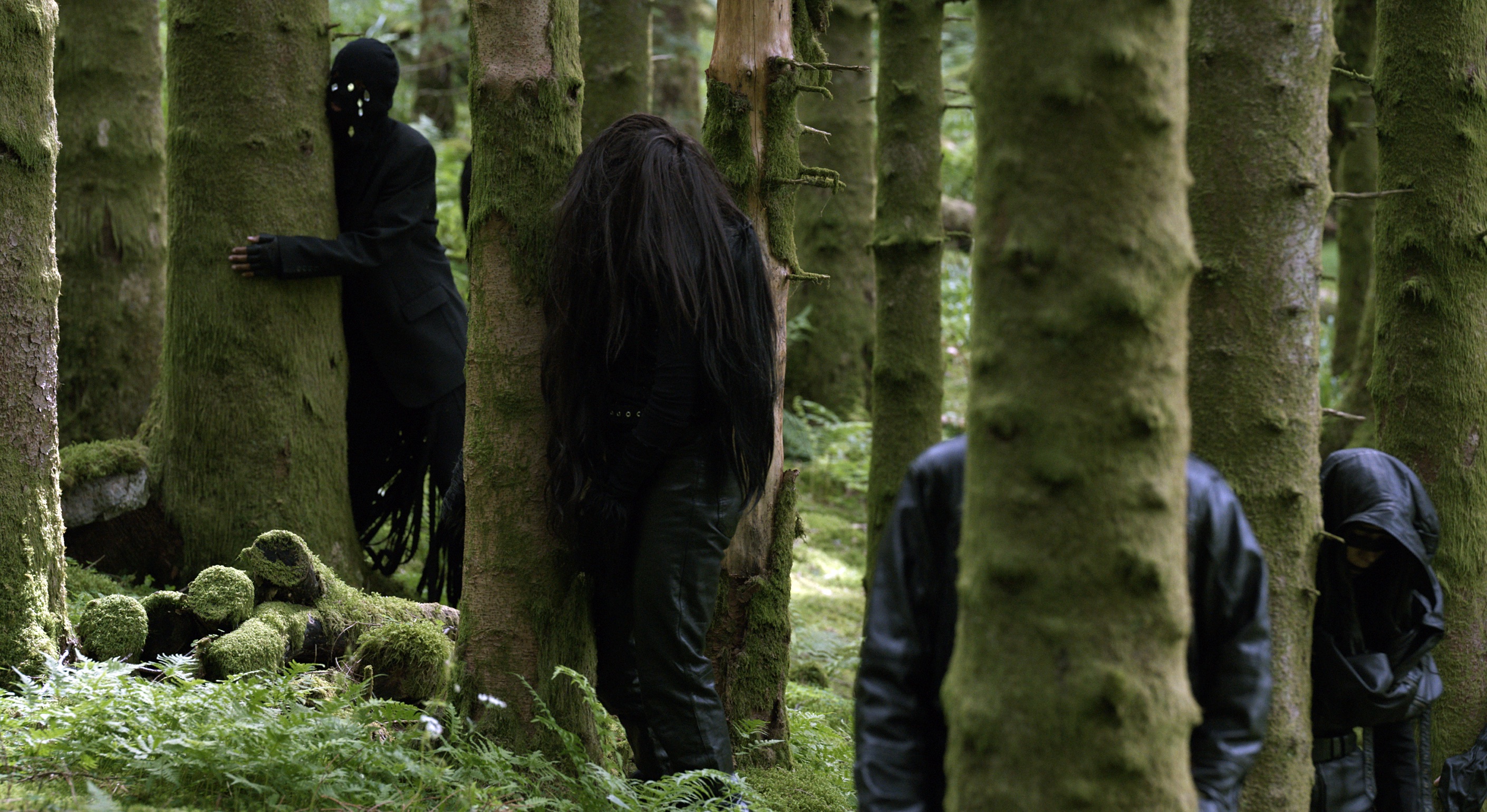
In this same post-apocalyptic present, in a vast forest, lives a community that worships trees and plants. Somber creatures, dressed in shreds of what once clothed humans, they burrow into the plant world, mingling with humus, ferns and roots. They know that they owe their survival to trees and moss, and that all life on earth can be traced back to common ancestors arrived from the oceans. In search of their vegetal filiation, of the links that unite them to this forest-world, they dream of becoming landscape and be part of this great breath.
Filmed near Bergen, in Norway, Landscaping brings to life beings who seem to have emerged from our collective memory, sketching out a possible new relationship between humans and landscapes. In these unexpected fictional perspectives, we can read the most destructive human actions, images of an endangered and degraded environment, but also the beginnings of new cohabitations between bodies and nature. A becoming landscape.
Landscaping is a poetic fiction that brings together the geological and biological time of two landscapes born hundreds of millions of years ago. The work confronts our coexistence with the non-human world in a post-anthropocene era. It is a way of questioning how imagination and bodies can evolve in post-capitalist and ecologically non-toxic directions. How can we engage in a different collective relationship with threatened ecosystems?
Landscaping is also a critical gesture that addresses the ethical and ecological implications of performance, cinema and artistic practice today. This work is a modest attempt to create ephemeral encounters and cohabitations without producing waste or toxic traces in natural environements. Leaving the theater to intervene directly in nature forces us to think about our actions and practices in their broader socio-economic and ecological contexts. It's by taking part in the landscape that we can question its future and our responsibility for it.
Director Eszter Salamon Producers Anita Norfolk & Elodie Perrin Director of Photography Mattias Pollak Assistant director João Carvalho Original music Carmen Villain Editor Alexandra Láng Costume design Eszter Salamon Costume design assistant Laura Garnier IRCAM computer music design Augustin Muller IRCAM sound diffusion Clément Cerles Performers Adrian Bartczak, Aslak Aune Nygård, Brecht Bovijn, Caroline Eckly, Dawid Lorenc, Gaspard Schmitt, Ihsaan de Banya, Irene Vesterhus Theisen, Mai Lisa Guinoo, Manon Campion, Nadege Kubwayo, Naomi Schouten, Noam Eidelman Shatil, Ole Martin Meland
Production manager John-Kaare Hoversholm Junior producer Simon Eidesvik Focus puller A-camera Jonathan Ottesen B-Camera Operator Birk Øren Focus puller B-camera Petter Stokke DIT Jonathan Ottesen Production assistants Camilla Schjøtt, Benedicte Kollseth Medic, Driver Per Rutledal
Artistic director Carte Blanche Annabelle Bonnéry Production director Carte Blanche Møyfrid Fuglestad Head of costume Carte Blanche Indrani Balgobin Tailors Martina Wilhelms, Krishna Biscardi Props & Masks June Olsen On-set Dresser Renate Rolland Producers Folk Film, Studio ES in Co-Production with Carte Blanche, The Norwegian National Company of Contemporary Dance Coproduced by la Biennale de Lyon, le Centre Pompidou Paris, KODE Bergen, IRCAM, Festspillene i Bergen
With the support of The Audio and Visual Fund, Bergen Kommune, Western Norway Film Centre, DRAC Ile de France Thanks to Alexandra Wellensiek, Lívia Páldi, Zsolt Kozma
![]()
![]()
![]()
![]()
![]()
![]()
A video installation
In a post-apocalyptic present, a nomadic community survives by traveling from island to island according to the seasons. Strange beings made of detritus, objects and materials washed up by the ocean, laden with toxic particles, they are no longer truly human. Their mutated bodies have found new senses to feel the heat, capture the sounds that nourish them, perceive the waves that orient them. So they follow the movement of the sun, entering into rituals that connect them with the cosmos. Now cleansers of their infested world, they seek alliances with the living organisms and mineral forms that surround them.
In this same post-apocalyptic present, in a vast forest, lives a community that worships trees and plants. Somber creatures, dressed in shreds of what once clothed humans, they burrow into the plant world, mingling with humus, ferns and roots. They know that they owe their survival to trees and moss, and that all life on earth can be traced back to common ancestors arrived from the oceans. In search of their vegetal filiation, of the links that unite them to this forest-world, they dream of becoming landscape and be part of this great breath.
Filmed near Bergen, in Norway, Landscaping brings to life beings who seem to have emerged from our collective memory, sketching out a possible new relationship between humans and landscapes. In these unexpected fictional perspectives, we can read the most destructive human actions, images of an endangered and degraded environment, but also the beginnings of new cohabitations between bodies and nature. A becoming landscape.
Landscaping is a poetic fiction that brings together the geological and biological time of two landscapes born hundreds of millions of years ago. The work confronts our coexistence with the non-human world in a post-anthropocene era. It is a way of questioning how imagination and bodies can evolve in post-capitalist and ecologically non-toxic directions. How can we engage in a different collective relationship with threatened ecosystems?
Landscaping is also a critical gesture that addresses the ethical and ecological implications of performance, cinema and artistic practice today. This work is a modest attempt to create ephemeral encounters and cohabitations without producing waste or toxic traces in natural environements. Leaving the theater to intervene directly in nature forces us to think about our actions and practices in their broader socio-economic and ecological contexts. It's by taking part in the landscape that we can question its future and our responsibility for it.
Director Eszter Salamon Producers Anita Norfolk & Elodie Perrin Director of Photography Mattias Pollak Assistant director João Carvalho Original music Carmen Villain Editor Alexandra Láng Costume design Eszter Salamon Costume design assistant Laura Garnier IRCAM computer music design Augustin Muller IRCAM sound diffusion Clément Cerles Performers Adrian Bartczak, Aslak Aune Nygård, Brecht Bovijn, Caroline Eckly, Dawid Lorenc, Gaspard Schmitt, Ihsaan de Banya, Irene Vesterhus Theisen, Mai Lisa Guinoo, Manon Campion, Nadege Kubwayo, Naomi Schouten, Noam Eidelman Shatil, Ole Martin Meland
Production manager John-Kaare Hoversholm Junior producer Simon Eidesvik Focus puller A-camera Jonathan Ottesen B-Camera Operator Birk Øren Focus puller B-camera Petter Stokke DIT Jonathan Ottesen Production assistants Camilla Schjøtt, Benedicte Kollseth Medic, Driver Per Rutledal
Artistic director Carte Blanche Annabelle Bonnéry Production director Carte Blanche Møyfrid Fuglestad Head of costume Carte Blanche Indrani Balgobin Tailors Martina Wilhelms, Krishna Biscardi Props & Masks June Olsen On-set Dresser Renate Rolland Producers Folk Film, Studio ES in Co-Production with Carte Blanche, The Norwegian National Company of Contemporary Dance Coproduced by la Biennale de Lyon, le Centre Pompidou Paris, KODE Bergen, IRCAM, Festspillene i Bergen
With the support of The Audio and Visual Fund, Bergen Kommune, Western Norway Film Centre, DRAC Ile de France Thanks to Alexandra Wellensiek, Lívia Páldi, Zsolt Kozma







 ©Matthias Pollak